
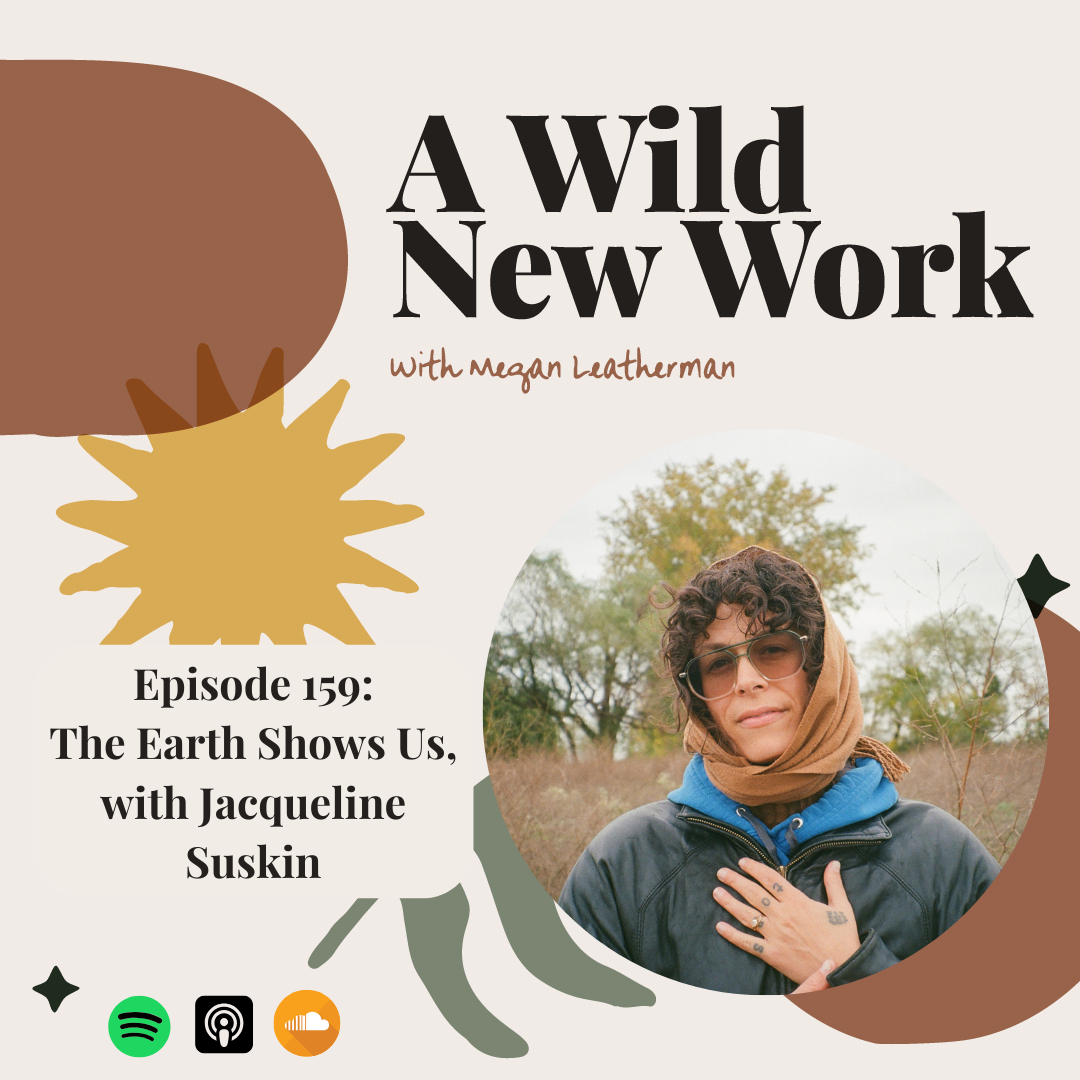
In this conversation with the gifted author and artist Jacqueline Suskin, we discuss what she's discovered about creating in tune with the Earth's rhythms, how to prepare for Winter, and how she communicates with the land.
To connect with Jacqueline, visit: https://www.jacquelinesuskin.com/ and https://www.instagram.com/jsuskin/
Click here to listen to this episode on Spotify
Click here to listen to this episode on Apple
You can also play the episode via SoundCloud below, or by searching for “A Wild New Work” wherever you stream!
A written transcript can be found below the embedded player.
If you enjoyed this episode, please help get it to others by subscribing, rating the show, or sharing it with a friend! This podcast is nourished and made possible by the support of Eagle Creek members.
Resources mentioned:
*Needing More: a 4-week Pilgrimage into Darkness: https://mailchi.mp/awildnewwork/gd63pkceqy
*All my classes, events, and writing can be found at: awildnewwork.com
Megan: Welcome to A Wild New Work, a podcast about how to divest from capitalism and the norms of modern work, and step into the soulful calling of these times we live in, which includes the call to rekindle our relationship with the earth. I'm Megan Leatherman, a mother to two small kids writer, amateur ecologist and vocational guide. I live in the Pacific Northwest and I'm your host today.
Hi, friend, and welcome. I'm so glad you made your way here today. I hope you're taking good care as we venture deeper into the darkness of this autumn cycle, we are really deep in it now. I hope you're letting go of as much as you can. I hope you try the guided meditation that I released last week, November 4th, if you haven't already, and that you're just being as kind to yourself as you can be.
As you maybe hold on to things that you aren't ready to let go of, or just recognize the push and pull of that, or grieve the loss of things that have come to an end this autumn season, wherever you are and however it's going. I just wish you well. Today I get to share a conversation that I had with Jacqueline Suskin.
Jacqueline is the author of nine books, including A Year in Practice and The Verse For Now. She has composed over 40,000 improvisational poems with her writing a project, Poem Store. Suskin lives in Detroit, where she works as a teaching artist, bringing nature poetry into urban classrooms.
I have known Jacqueline's work for years, I have commissioned a poem from her poem store for a dear friend, and I was so excited when our mutual friend, Uma Girish, who's been on the show, offered to introduce me to Jacqueline. Jacqueline is a true earth devotee, and in this conversation we talked about her earth practices and seasonal attunement, how we can begin to prepare for the winter now.
And Jacqueline shared some beautiful poetry in this conversation, and I hope you just get cozy or just really let it nurture you. I think you're gonna enjoy it. I just have a couple of announcements before I take you into this conversation. The first is that our Needing More darkness practice starts November 30th.
This is a free annual program I offer, it's four Sundays in a row of turning off your electric lighting. It's very simple, not easy, but simple and profound, and it's one of the most practical but mystical ways to work and come into alignment with the autumn season. So for four weeks, once a week, you'll get an email from me that just helps you understand how this works, how to do it, what to do, it gives you some encouragement and you'll be part of a large group of people who are doing this with you, and uh, I encourage you to check it out and to enlist your housemates or pets or beloveds in the practice. I know a lot of people do it with their out of town visitors and that it can really open up different kinds of conversations than you might be used to having.
And it's offered at this time of year because this is the darkest point in the seasonal cycle. And it's also offered, it's an antidote to the just neon brightness, busyness and loudness of the holiday season. Not that we can't have that kind of fun too, but when that's all we have, we miss out on the deep, deep, quiet that is coming to the fore at this time in the cycle. The darkness is very present in these days here in the Northern Hemisphere, and we can surrender to it and find a rest and a quiet and an opening that just isn't possible at other points in the cycle of the year. So I hope you'll consider joining us.
You can learn more about that at a wild new work.com. It's right there on the homepage. This year I'm also offering some supplemental materials to Eagle Creek members. So a best practices and supplies guide a guide to an outdoor darkness practice and audio recording of winter solstice, practices and rituals that they could do, and a guided meditation to help them embody the transition from the autumn to winter that will happen in December. So if you are an Eagle Creek member thank you, you can sign up for needing more and you will get those extra materials if you're not, uh, Eagle Creek is a community of people who are pitching in every month to help make this show possible.
And we also do some deeper work together through monthly, behind the scene emails and other things like needing more that I offer. So if you are loving the show, if you have benefited from my work, or if you would like to go deeper in the needing more process, I encourage you to check out Eagle Creek at a wild new work.com/eagle-creek.
The last thing I'll say is that if you have been courting the idea of a change in your working life, if you know that something about the way you earn an income or give of your gifts or relate to your calling is feeling sticky, the next meant for more vocational small group begins February 4th, right around the time of in bulk, which is like the very, very first stirrings of spring.
And I would love to have you in that group if this work calls to you, if you know that something needs to change, but it's been difficult for you to do yourself, which is very understandable and you can learn more about that at a wild new work.com as well. Okay, with that, I wanna take us into our opening invocation so you can settle into your being for a moment.
You might wanna take a deep breath or let out a heavy sigh.
May each of us be blessed and emboldened to do the work we're meant to do on this planet. May our work honor our ancestors known and unknown, and may it be in harmony with all creatures that we share this earth with. I express gratitude for all of the technologies and gifts that have made this possible, and I'm grateful to the Multnomah, Cowlitz, Bands of Chinook and Clackamas nations among many others who are the original stewards of the lands that I'm on.
May this episode be one small stitch in the great reweaving of right relationship that so many indigenous teachers are calling us into. Well, Jacqueline, thank you so much for being here today.
Jacqueline: Thanks for having me.
Megan: I'm excited to hear a little bit from you as someone so in love with the earth, what the earth around you looks like in the autumn season.
I wondered if you could start us off by just giving us a sense of what Autumn is like, where you are and what you love about how the landscape changes there.
Jacqueline: Yeah, it's, it's interesting that we're recording this today because today feels like the actual first day of fall. Like it rained and it got cooler, and just yesterday it was still summer vibes, but today it's like a chill in the air and I, everything got wet.
So I imagine that that means like the leaves will start changing. Um, I'm in Detroit, so here the seasons are very obvious and very straightforward. So when like the shift happens, sometimes there's a little tease and then it'll go back to being summer at the, I think this is the last, I think now it'll really start changing.
So I'm excited and I feel that kind of… Even though it rained, you know, when everything feels light and alive after rain, I'm like, ooh, there's an excitement there.
Megan: Yeah. Oh, beautiful. And so what is, I know there's a lot of deciduous trees out there that are very big. Like are there, um, what are the colors? Are there certain nuts that you look for? Like how does the season express itself there?
Jacqueline: Yeah. There's beautiful maple trees that turn bright red, look like fire. Um, and there's a lot of old trees here in Detroit, so they're huge, you know, lining the boulevards and things. And those trees, you can see them kind of express a different part of their age when fall comes around.
Like, I just always notice, oh, that tree is like. Dead on that part, and it's dead forever there. But now the rest of it looks like it's dying and I don't know, there, there's a lot of, uh, of nuance to the trees that have been here for a long time. I get really into looking at them in the fall. Um, and then it's funny that you asked about nuts because just the other day I was, we have a black walnut tree in our yard and I, for some reason, forever thought that you couldn't eat those.
And then I, but I learned that you can. And so I was researching how and when, and I think we kind of like just missed it this year. But then I was, I logged it in my memory like, oh, next year, this is the time of year when the black walnuts fall. And I noticed it this year and I was like, oh, this is the first year we've lived in our house.
So there's a lot of new things that the fall is showing to me here that I, I hadn't seen before. 'cause I hadn't really been fully present for it. Mm-hmm.
Megan: So you are someone who has studied the seasons, especially for your book a year in practice, and I'm wondering if you could share with listeners the seasonal cycles that you lay out in the book and why you connected the seasonal rhythms to the rhythms in one's creative life.
Could you talk about that?
Jacqueline: Yeah, absolutely. I feel very much like all of my work with the seasons and noticing how the seasons affect me. I, I started doing that noticing and that documenting, because in my creative practice, I felt myself kind of needing a rhythm and some guidance. Like I, I was like, obviously I can't just be productive all the time and I kind of.
Was trying to learn like, when am I most productive and when should I give myself a break? And you know, knowing that all of those rhythms are important to process, I was like, is there a practice I can do to get better at knowing that part of myself? And I feel like for the most part, a huge piece of what my work is trying to do in general as a poet is offer up these reminders.
And sometimes they're reminders for myself and they're very like personal poems, but I know that they'll kind of translate something universal and so I share them. And then sometimes I feel like there's just information that comes through that's like a reminder for all human beings. And a lot of my work has sort of been rooted in that for a long time of just receiving these, you know, big hits of information that feel like, oh, this is just important.
Everyone needs to remember this. How do we work on helping people remember, um. So the seasonal rhythms were a big part of that. And once I started looking at them and noticing them, I thought, you know, this is when, this is the time of year when I know to rest. And in winter I do all these specific things that involve turning inward.
And not all of them look like some of them. A lot of things in the book are just me being like, and rest now. And now maybe rest again. But, um, there's also a whole other aspect to it that's like, in certain moments of the year, it's really important to kind of like teach yourself to harness the energy or tread lightly and don't, don't have a false start.
Like all these different things that I think each season reflects back. So winter is this inward time and I feel like the fall right now getting ready for the winter, preparing, stockpiling. Doing things that are just very human, like making sure you have enough food and a plan and how are you gonna stay warm, and all these like very basic level things.
But then the way that applies to creative practices, usually in the winter I'm meditating deeply on like what I wanna make next and I'm not necessarily making it. Spring is kind of the time for making, and uh, in fall I'm sort of preparing myself. How can I be in a meditative state like that? Like where am I at in my life?
How much time do I have in the day to be on retreat or writing? And that changes, but I'm asking myself these questions and, and then spring, you know, is when it all comes to the surface and you don't wanna step too quickly back into that big, forceful time of creation because you can kind of zap yourself, um, or get, you know, it's the, the frost comes back and winter isn't actually gone.
And, you know, things like that really apply to, I think, creative practice as well. So I just found all of these relationships and when I sat down to research and write the book, I just, I, I was able to kind of just engage with the seasons here in Detroit and just test out these things that I thought might be true.
So I basically had a year to like, interact deeply with the seasons here and, uh, kind of mine this information from that.
Megan: And what do you feel like. This kind of rhythm gets you, not like it has to pay a dividend or anything, but what do you feel like is different in your creative life as a result of moving through this rhythm versus if someone was just trying to do all the things all the time?
Jacqueline: Yeah. I think it just feels more honest. It's like this is what we're actually made to do. I, that's the why the reminder part feels so important. It's, of course, everyone's going to have their own unique approach to how they connect with the seasons. Where you live will impact that. You know, the seasons are very different for you than they are for me, um, personally, and then also just, you know, the actuality of what happens in whatever biosphere you live in.
And so I think, I don't know, there's just this deep seated. Feeling that this is all information that's here for us and we've lived with it for a millennia, and it's just for us to remember. And so it doesn't feel super unique to me. I felt it felt really fun for me to connect my own personal, like spiritual creative practice to the greater concept of the seasons.
And that felt like a unique, like, uh, that was my approach. Um, but then the actual information in there and the way the seasons affect us, it feels kind of also just, I keep saying that it's not just a year in practice, like practicing your craft as an artist, but it's like a year in practicing life and just how, how to like show up to live in a way that feels maybe a bit more aligned or grounded or healthy, however you wanna put it.
You know? Um, I think that that's, there's a lot of things the earth is constantly offering us. We forget exist, and those things are usually things that sustain us. So
Megan: yeah, that's beautifully said. Yeah. I have found that it doesn't take so much effort to start aligning with the seasons. It's so natural.
It's kind of like once you see them, it's just like, oh, like you said it. It's so honest and truthful and just. Easeful and I have found that in doing it, my kind of inner experience has started mirroring what's happening on the land more so that it really does feel like my springs now are a lot more fruitful than beforehand, and that I really can, like, really things this autumn have already started falling away and without a lot of trying.
So I don't know if it feels like that to you, but I have found that it, it didn't take like years and years of study and clamoring. It's just right there, you know?
Jacqueline: Yeah. Something in what you were just saying, like the way it felt in my body or something reminded me. Like the, the big takeaway from from this I think also is that like this book is very much like.
Looking at capitalism and the way capitalism trains us to be productive like a hundred percent of the time. Mm-hmm. And I think just remembering that the earth already gave us all this information and showed us like how to have a cycle and that we are earthlings and that maybe that might be a better way to go about things.
Um, or at least the source of us being able to have time and energy enough to think of a better thing mm-hmm. To do than capitalism. Mm-hmm. Um, I, I, I just think that that kind of stuff, it's like for a long time I have been trying, you know, to fight for that kind of memory to be shared in any way that I can conjure up.
Um. I feel like I've made a lot of information about it. So I'm like, I think I've done my duty. I don't know what will come next, but I still enjoy talking about it and thinking about it because yeah, even when you're speaking about it, my body just says to me that this is right. This is the thing I need.
I need you to like, remember when to slow down. I need you to remember the ways I get energy from the earth. Mm-hmm. And like, remember to collect it and receive it instead of just feeling so overworked and drained all the time and not noticing, and not, you know, so that, that all of that feels like a long winded, floaty response to your question.
Megan: I love it. Yeah. Yeah. We talk a lot about capitalism on this show and the sort of dissonance between capitalism and the long ancient sustainability of the earth and how. Capitalism is so precarious and can't sustain itself, and we can just turn our heads very gently and see that there's this whole other way of being and living.
And I guess that makes me think, I would love to hear kind of what your earth practice looks like right now. Being in Detroit, there's a lot of people who live in a, an urban setting and they're like, you know, and I do too. And so when we talk about like the land and the earth, it can feel hard to access.
And I'm curious what your earth practice looks like right now, if you wouldn't mind sharing.
Jacqueline: Yeah. Um, I've been doing a lot of swimming. Swimming is like, like in the river. Um, the Detroit River. Uh. Or Lake Michigan. I've gone to Lake Michigan a couple different times throughout the summer to have some big resets in that old, beautiful, pure body of water.
Um, so simple things like going outside or going swimming. Well, swimming doesn't even seem simple to me. I feel like swimming in a fresh body of water or in the ocean, or in a river or a lake, uh, all of that is just really gives me a, a big reset. But, you know, I'm obviously not doing that all year long here in Detroit.
So I, I like to get it in when I can. Um, so that's been a big part of my summer is like letting myself have many, many opportunities to swim. Um, and beyond that, I think last night was the full moon and I've been putting my garden to rest for the winter, like my vegetable garden. The flower garden. I just let do whatever, and then I take care of it later.
I think it, the, the bugs enjoy that, that part to be left. So I, I try to leave that part. But the, the vegetable garden, this is my first year with my own vegetable garden at my own house. I've worked on a lot of farms and, and I've built a lot of gardens, but none of them have ever been just mine. I've always like, you know, been learning from someone else, basically, um, tending to their garden.
And so tending to my own garden here is probably the greatest resource I have to feel this like deep, deep earth connection. And we have a lot, we have a full lot next to us that we've turned into a garden and all behind us, we own other lots where we've planted nine or 10 trees and it's a, it's, we're making our own little forest here and.
I'm doing that with my partner. So that feels really special too to like, I think part of earth connection for me is remembering that human beings are also earth. And so connecting to other humans while I connect with nature feels not what I'm usually trying to go for. 'cause honestly, I'm a little hermit freak and I'd love to just be alone in the woods for the rest of my life probably.
But I have this understanding of being human and, and wanting to be with other people and be like, we are this planet also. And again, just another reminder. So building that with him has been really special. So pretty nice collaboration.
Megan: Yeah, that sounds amazing. I can picture it in the midst of buildings and concrete and just the life that's being made there.
I wanted to ask you if I'm jumping ahead a little bit, but I was really curious, you know, in reading your poetry, there's such a like intimacy and uh. Just the way that you like, I don't know if you would call it like channeling, but just receive information from the earth and share it in your poetry. And I was wondering, since this is something that we've talked about on the show before and something that I think a lot of people struggle with as we try to relearn and remember how to connect and hear from the earth, how do you hear from the earth?
Is it like you audibly hear things or you just feel things or you follow threads in your body or you have a dream? Like, could you tell us a little bit like in the nitty gritty almost how you communicate with the earth?
Jacqueline: Yeah, I, I love that question. I'll answer that question one first with a conceptual thing that I think is really important, which that is.
I love to think of imagination and intuition or like another sense like that. Um, being the same thing, like I think my intuition and whatever voice I hear within me is the same as my imagination. And so I don't decipher between, like the reality is that the tree spirit is actually speaking to me. I intuitively can like tune into a language older than time and I'm like, yeah, I can, I don't know if that's my imagination or what, but it doesn't matter to me.
Like there's no actual separation there. And I'm like, whatever that is, is important enough for me to share and witness. And sometimes I can tell that it's not me. Like sometimes I'm positive and that also doesn't mean I know what it is. But I think that just trusting that whatever comes through that attempt to listen like.
So much time spent listening. I can't even that, that was a big part of living in Northern California and writing my last book was I gave myself a lot of time to be alone in the woods and just deeply listened to the earth. And I wrote a whole book, you know, of poems after that and it kind of destroyed me.
It was a really epic process to try to put myself in such a vulnerable place to receive information and like be able to also share it. And I still think now, I, I mean, I think I just hear the earth constantly, that my mind is always working in poems and most of that looks like observation and appreciation of place and where I'm at and just being present with where I'm at.
And then my, my mind, it comes up with. Language in response to that. But a lot of times that's not even an active mind thing, it's just me kind of communicating my awe and in exchange maybe sometimes receiving some clarity or some information. Uh, and a lot of times that stuff is just for me and just for my life, but then if I try to put myself in the mindset of just being a human on planet earth and maybe we all need some guidance, then it, you know, I, I believe in that too, so.
Megan: Oh, thank you. It's helpful. I'd love to hear a little bit more about the process that nearly destroyed you. It sounds like, like what, what was that opening up like? And, yeah. Could you expand on that a little?
Jacqueline: Yeah, I feel like I'm still processing it. I mean, this is my ninth book of poetry, so I think I put so much.
Effort into it in a completely new way, like letting myself have that deep, deep meditative process and practice with being with the earth for many, many, many hours alone. And I think that like what came from that was also paired with very deep human things I was going through in the human world. And so I wove those things together.
So that's, you know, even that is just so much practice and attention to detail. And then also just like complete vulnerability, like having to tell people like, here's these things I wrote. I care enough about this. And think it's, it's a gift to you. And that there's like a whole world of ego that you have to sift through all the time with that.
And. This book was particularly me, like releasing a lot of my, my, my ego. I feel like after that my, I had this like big ego death, which I'm only still comprehending, and it felt all of it was, was reflected through the poetry. You know, it's all there on the page. So there's that like, putting that out into the role, but then there's the immense effort of actually putting it out into the world, which I did do in spring.
I did it just as well as I could, but it, it's exhausting. It's just like touring and planning the tour myself and, you know, it's not a like financially supported, you know, world to be in. It's just wild. It was a lot and I think I knew that it was gonna be a lot. I accepted that and I turned 40 this year, so there's.
A real sense of like, this is just a portal I'm going through in the middle of my life, and I, I, I'm in it. I'm riding the ride. You know, I'm here for it, but it was hard.
Megan: Yeah. I believe you. Thank you for that work and sticking with it and moving through the portal. Maybe just for listeners, could you say the name of this latest book so people, if they wanna go look at it real quick?
Jacqueline: Yes.
Megan: Share the title.
Jacqueline: Thank you. It's called The Verse for now.
Megan: Mm-hmm. Beautiful. So it sounds like you've been on a journey this spring and summer, and now we're here in autumn. And you mentioned earlier that this is a time when you're sort of preparing for the winter and considering like how much inwardness you can give yourself.
What are some of the practices that you use in the autumn? What does your creative process look like? Even just this autumn, what? What are you feeling into right now? Could you share a little bit about that?
Jacqueline: Yeah, I think I said this word before, this like preparatory time, this preparation. And for me, having gone through such a wild ride in the spring.
I let myself rejuvenate over the summer. I, you know, I, I have the, I'm a well-resourced like healer. I can heal myself and like do all these things. It took some time, but summer is such an amazing time to be like in the sun and be with people and just like be loving and together and present and outside.
And I just really soaked it up. So I feel like now for my preparatory period, this like fall session, it has an electric spark to it, like Spring does. And so it's like, okay, now I refine what am I gonna be meditating on the, in the winter months? Like, will I be working on a new book of poems? Maybe will I be, you know, calling in some other kind of.
Path that should open for me, for my career if I could like, give myself the time to see it. It's a great time for research. So I prep myself in fall for what kind of research I wanna do in the winter. Um, and that can look like for my actual life path or really just for like, what do I wanna do with my artistic path like I am.
Someone who's been making artwork for so long now that like each chapter of it and each book and each focus, like I, I just have to give myself the time and space to conjure those things up. It doesn't just come out of thin air without some kind of like nurturing. And usually that nurturing is really just for like my body and my mind and my spirit to like rejuvenate.
And then the idea just is when it, when it's obvious what is, is coming out. Like in the wintertime, like when I'm really like sitting there and letting myself see it all, it's obvious because I've let myself have the time to clear away what I can clear away. And, and fall is the time for that clearing.
You know, that's when I'm like having fires and like burning out concepts that maybe have played themselves out. And uh, you know, it can be really like macro too on like this level of like. What we're doing in the fall, politically, what we're doing in the fall is this big, kind of like clearing out, readjusting, getting ourselves in line for the next phase.
And I've been thinking about, and I'm like in the fall of my life and writing about it, there's all these different ways you can apply the, the metaphor, but also the reality of these transitional things that are just built into our human timeline.
Megan: Mm-hmm. I'd love to hear a little bit about some of your meditative practices for the winter.
When you say you are conjuring and you know, listening very deeply, is it like you are gonna leave your home and be on a retreat for a few months? Or is it at home and quiet? Like, just what are the, what does that look like or what do you think it might look like? This upcoming winter?
Jacqueline: Yeah, for this winter, every winter has some sort of retreat.
In it in some way. Um, even if I'm working full-time, I find a way to have that mindset of like, I'm gonna give myself at least a chunk of the day, but ideally it's a big chunk of time. Um, and that's not usually possible, but I'm in my own home now and having a retreat in your own home and living somewhere where you work, there's a lot of hurdles around that.
But I think for me, it, it really can come down to making a plan that works for whatever my life looks like at that time. So making a schedule and the way that I figure out like how to do that is usually like I have to do some meditating first. I'm not just a person who's like, you know what, I'm gonna write this like, made up schedule down.
And then it'll, I'll just do that. I have to base it off of like where I'm actually at as a person and be like, what, what kind of energy do I have? What kind of mood am I in? But I do like to give myself, like, for this week, I'm gonna try to get these things done. I mean, I do that all year long. I'm a, I'm a big list person, so having these like preparatory fall lists help me in winter to not have to like do really any planning.
That is a huge meditative practice in winter is not making plans. I don't have to go anywhere my, it's snowing. No one expects me to be anywhere. I could take a bath. I do a lot of bath time in the winter. And whenever I talk about this retreat concept, I've had a lot of friends who are artists ask me to make a book about my retreat practices.
Because when they try it out for themselves, it's really helpful. And I used to run an artist residency where people would come on retreat and I would like kind of guide them in that. I don't, I do think that I, I know the magic of retreat and I can share it, but there's something about it that just feels like.
First of all, it's like, duh. Of course someone would like, you know, be restored and find creative, uh, proof in that space, whatever. But it feels just so incredibly privileged. It's like not accessible, it capitalism. We do not have access to just go on retreat whenever we want for the most part. And I feel like whenever I'm talking about my experiences with this, I was just this young punk who was like, I could do whatever and I'm gonna like go live in someone's, you know, weird ranch for months out in the desert while they're not there because I don't have responsibilities or children or a mortgage or, you know.
And so I'm in this new phase of my life trying to think about like, the reality of these things. And I'm like, I don't wanna write about that. It's fun. Write about that. You know, I, but I, so I'm glad that like, some of that magic of my youth and my, like, artistic, creative, youthful truth is written down. And I, I still do practice those things because I am lucky enough at this point in my life to have been a writer for my, my entire career.
So I've had the privilege of exploring what it takes to be a creative writer as my job, and it takes a lot of self-care, way more than I ever could have contemplated. Um, and I, I think that's a really difficult thing for people to understand. And so weaving that into understanding winter, it's just like this great metaphor that helps people kind of recognize it in a really like base logic way.
Like, this is what this cold, dark season does to me. It probably does something similar to you. Let's not try to do too much in that time, you know?
Megan: Yeah. I love the way you framed that. Yeah. I feel the same way about retreats and just the, yeah. I think a lot of people feel the tension between knowing we need that and also recognizing that collectively we don't really get permission or the chance to winter as we should, but I think there's a lot of power in carving it out for ourselves when we can and showing others that that's possible and being in that together.
What has it been like as a professional writer to, um, honor your own creative cycles and the seasonal cycles? Like as you're interfacing with publishers or readers or people who are on different timelines or deadlines, like what has that, well, what has that been like for you?
Jacqueline: I feel like I have, well, I mean, to have written nine books since 2010 is a lot of books.
And I think that one thing that has shown up for me as a big difference in kind of the way I think a lot of people might imagine what it's like to be a writer is something that I used to sort of imagine, which is this old school vision of what it is to be a writer and like what that requires and the, the big chunk of that, it's still true to be, you know, kind of the hermit on the mountain, getting the download.
And then in my mind, that used to be like, and then you would like send that in the mail. And that's all you had to do. I was like, that's it. It's amazing. I am a writer. I'm getting my information out. People wanna read it. People are are, you know, celebrating it, enjoying it. I know all of this because, you know, I receive all this information back from people, but there's this huge portion of effort and labor that happens in between that, which is all on me as the writer.
And I don't think that's something that is sustainable in general, but for someone who is like tapping into, you know, the deepest, most intense feelings all the time, there's just, just like how to figure out how to have like a pause in that. And I think that luckily the publishers I work with are all people who I've been connected to through.
Friends, or, you know, through Sounds True as an incredible publisher, and they know they're tapped in, you know, they know. So they're not pushing me to put a book out at a weird moment. Usually it's actually timed pretty well. Although I will say overall, I can't quite comprehend the way that the, the Christmas holiday season time falls on the calendar cycle.
I'm like, that is when I'm done. But no, that's not, I don't know how that happened, but I think it's a mistake. Um, but I think it should just be like, not. Celebrated right then. It's just a strange time of year to like put so much effort and energy into being with people and, and, um, I don't know. I think that that's been a part of putting books out is like, here you go, like a, a year in practice came out at the beginning of December, which I was grateful for.
Um, but it was, I was still like, well, it's winter, like we're on the downward slope here, and then you have to promote your books for so long. Um, I mean, I'm, I'm still doing it right now. It's like, this is years later. And so there's just all these pieces and parts to it that I think, like as someone who would love to just be alone in the woods, I've stepped into some other aspect of what it looks like to try to, you know, bring the language down from the little hermit hole.
And I don't know, I think it's been a beautiful experience for me, but I definitely feel like. It was something that as I passed through this portal that I'm talking about, there's a lot of things that I'm shedding from maybe what I was just willing to do when I was younger. 'cause I was young and I was just doing it for the heck of it.
Megan: Yeah. Oh, I really resonate with a lot of what you shared. Thank you for giving us a little insight into what writing is really like and what it means to be a professional writer. And yeah. I struggle every December and. You know, we celebrate the winter solstice in our little family, but then there's the whole like cultural overture of the holidays and it, yes, I just, everyone is so tired and it's just so incongruous with what the land is doing and I just think, I hope more and more of us are realizing the mismatch of that and that some other new rhythm might come to the fore 'cause.
Jacqueline: Yeah, I mean that's a really, I think that's an amazing little segue, which is that like these traditions that we are stuck in these cycles. That we are stuck in these things that like aren't serving us, they're not working, in fact they're working against us and the earth a lot of times, like all of that stuff is in the midst of also passing through a portal and like, you know, having a rewrite and, um, I think that that kind of, that that whole.
That whole picture of that change, it's hard to talk about. 'cause I'm like, it's painful. And like this thing, what's happening to the earth and the climate crisis, like the seasons are already not what they used to be.
Megan: Mm-hmm.
Jacqueline: And we're gonna witness all of this massive change. And I think we're witnessing it on a pretty unique level.
Sometimes I wanna convince myself that all humans have been experiencing insanity forever. But I do think that somehow the crank has been turned in our lifetime and we're watching something get pretty outta hand. Um, not that it hasn't gotten out of hand before, but I'm, I'm really curious to be like, as the earth dies, you know, as big chunks of the earth are wounded, as we lose a lot, like the seasons are changing in ways that are pretty.
You know, vastly noticeable. I think that, I'm just curious, like that's like the huge, intense aspect of this other thing, which I'm just like, yeah, now all these human traditions and rituals and things will also like fall away and there'll be a, a rebuilding. I don't know. There, there must be. Mm-hmm. But I'm not sure.
We'll, we'll live to see it, but I'm, I'm fascinated by it. Mm-hmm. And I think that that. Fascination and like belief and trust in it is what allows me to kind of look at all of it and be able to love the like really beautiful, wonderful, joyous aspects and also like witness and feel the suffering and the brutality and my curiosity sort of stands in the middle.
Mm-hmm. It's like, what is this? Mm-hmm. And that, that's sort of how I got to the seasonal rhythms in the first place was just, I was just curious like, what could assist me in this process? The earth is so bountiful, it's always saying like, look over here and this thing makes you feel good and do this thing.
It relieves pressure and do that, you know, whatever. I'm like, there must be some information here for me. And so I think that like, is my overall sense of just having this curiosity that kind of keeps us, you know, hope and hopeless at the same time. I, I like to say that a lot.
Megan: Yeah. That sounds very humble and just write down on the ground, just watching it and being in it.
I really appreciate that. Is there a piece of poetry that you feel called to share? And no pressure, but this might be a good time.
Jacqueline: Yeah, I thought I would read the, um, preparation poem from the fall section mm-hmm. Of a year in practice. Note the metallic toll that vibrates in this final rush, the crisp call of creation that urges us to gather and arrange.
There is an electric spark that rises like a whip. Its cold. Voice is pertinent and wise. Preparing us to rest fall speaks to us with certainty stimulating our last outpour of energy. May we be rooted in illumination, robed in illumination, bending low to collect what we need, rising to the occasion of the harvest.
Wide-eyed and ready. With our skin still warm, we bow to the beauty of earth's fine shadow. It grows all around us with a smile of abundance, reminding us that we have time. We have the tools for this closing composition, for this conclusive song of bright instruction that is both an ending and a beginning.
Megan: Beautiful. What a gift.
Jacqueline: Um, I have this other piece that every section in a year in practice has these prompts from the planet, like what the planet would be saying to you. So maybe I'll read that too.
What do plants and other animals do in the fall? They gather their reserves of food, bury their stockpiles and store their reinforcements.
Each creature knows the cold that's coming. They respond and harvest With swiftness, the plants leave behind all reaching foliage. The core of each trunk is full and protected. See how the nutrients are left for the health of the inner world. The fungi rise into their fruiting bodies getting ready for their wet wealth of winter rot.
Everything participates in preparation, honoring this final act of earth's profusion. Remember, we are part of the same cycle. Remember to ask yourself, what is the natural world up to right now? How does it include me? How is it my mirror? I liked, I wanted to share that because I felt like some of your questions were sort of similar to that, um, in a way, and I, I just, yeah, I thought that maybe it would be nice for listeners to sit with those questions.
Megan: Yeah, those are beautiful. Yeah, I think that's something that's come up with, come up for me in the last few days. Actually. You said in the poem, I don't know if I got it right exactly, but you said, we have the tools, like we, you know, all of the other beings around us know how to do this, and I don't see in them.
The level of angst and fear that I feel in myself, even when I think about dropping all my leaves or letting this thing go to see if it will survive or come back in the spring. They seem confident and okay. And I don't know, you know, what the nut harvest has been like or how the squirrels are feeling, but they just seem at their work and it's just, they just have the tools.
And I find like myself and others are expressing just, I don't know, like fear I guess, or anxiety, like, what? I'm afraid to drop all these leaves, or I'm afraid to let go of this thing. Or I'm afraid to, you know, release and prepare and let the winter come and yeah. I just wondered if I just, I appreciate that you reminded us that we can do that and yeah.
Anything you wanna add?
Jacqueline: I think it's interesting to sit with that fear and. I think there's something to it. I think fear, I think of fear as sort of like a flag in the wind. It's like, hey, there's something here. Like, um, something our consciousness is hooked on, or, you know, the, there's this human story is so old and I, I keep thinking like, come on, can we please change this story?
Like, let's do something different. We know how we have the tools. We don't, we can, it doesn't even have to be a new thing either. There's like things that are ancient. What, you said something earlier, like about like something, the ancient rhythm of the, the earth and whatever. I'm just like, we know what to do.
This is probably what gets me the most upset about where we're at as humans is we have all the information. I'm not writing a brand new idea here, talking about, you know, the rhythm of the seasons and how they affect us. This is old. Mm-hmm. This stuff is ours to know and to like. Yeah, I, I really like thinking about what you're saying about like what we're shedding and being willing to shed it, and how I think that what that sounds like to me is, you know, us shedding capitalism and like how hard that is for us and how ingrained it is, but it's possible and we know it.
And that, I think is just the grinding between those things. It's just so hard. But I think that's what happens in transitional times, and I think this is a pretty transitional time. Um, um, my partner the other day said, you know, we're living in historic times and that's not a good thing. And I was like, yeah, no, it's, it's rough.
It is hard to be alive and I don't know, there's part of me that always thinks that. Maybe it's always been hard for everyone to be alive and that it's just a really intense thing to have consciousness in an earth body. And that experience is just, there's suffering to down to the last detail.
There's just always going to be, and I have a lot of acceptance around that. Um, but then I'm still so curious. I'm like, but could we ease the suffering? So I think that's really the tagline for, you know, a year in practice is this sense of like, how can you ease the suffering in your own body, mind, and spirit?
The earth is showing you how. Mm-hmm. Always. And every moment there's something to, you know, bring you back into your body, to bring you back into the present moment, to inspire you, make you think of deep time and the cosmos, all of it, you know, can be constantly. Realigning and you know, helping you adjust.
And I think that hopefully that these poems and these practices and these books that I create, you know, ha. Just help people remember that. Mm-hmm.
Megan: Definitely. What might you say to someone listening who perhaps has a creative heart or an artist's heart and they so badly want to give life to their practice and or creative life, but are in a job that takes a lot from them or are supporting others and have to earn money in another way?
What, I don't know, encouragement or perspective could you share to just help someone who maybe aches to do more of that but feels far from it?
Jacqueline: I think I would say just do it when you can, but make time to do it. And I think that that's one of the hardest things is a lot of times. We think we might need to be in a perfect set state of mind and mood and atmosphere to be creative.
But a lot of times I'm just thinking in a poem and it doesn't have to become anything for me to feel my creative self and nothing can stop me from doing that. So I feel very, like that's my deepest advice for people who are kind of stuck in the output. Like, how do you get it out? How do you like put it on the page?
How do you, and I'm not saying you shouldn't try to do that. I actually, you know, I work with people one-on-one all the time, helping them make books because I think books are an incredible thing just to birth. Mm-hmm. And just to get out of you. And I do think there is so much merit in the process of sharing or even just.
Making an object, you know, your words, your painting, your song, whatever it is. But I'm also like, it's actually just fine for most of the time to just be living in your creative self and letting your poems move through you. And, you know, every once in a while there'll be a moment, like, I, I'll write a poem and I'm like, I gotta write that poem down.
Like, I know when it's not just for me, and I can trust that, but I've also practiced knowing that. So I think, like, I've learned to let myself just have a lot of the poems that move through me. And when I was younger, I was like, write everything down. I'm journaling all my thoughts. And now I'm just like, whatever, I've, everybody already knows my thoughts, so I'm, I'm less inclined to force myself into the desk seat and into the journal and into the role of, you know, writer who makes a product.
Mm-hmm. I think that that also is something that people should still strive for because I love art and I love to bring art into my life and find inspiration and receive other people's language and just see how other people's minds work. Even just that alone, like just put your ideas out there so someone else can be like, wow, wow.
That's an interesting way to think and be. And I think even just that, that feeling, that passing feeling is enough.
Megan: Mm-hmm. Mm-hmm. Thank you. I've never heard it put that way. I love the idea of just living as your creative self, and then some of it will come out and be shared, but it doesn't all have to be on all the time or in some perfect setting.
Yeah, that feels very true. I know you've mentioned before, kind of how you're orienting to this time and what's been going on in your working creative life, but I'd love to hear anything else you wanna share about what you are sort of chewing on or curious about or wondering about researching this winter?
Like what's sort of happening in your working or creative world?
Jacqueline: Well, I have a nice collection of poems sitting on my desktop that I'll probably spend some time looking at and seeing, you know, like I bet there'll be a chunk of them that I don't wanna use and then I'll probably like understand from exploring them, like the theme.
And these poems are in this folder from last winter. Um, so last winter I went through all my journals and I went through all my files. That's what I do every winter. And I made this file of poems, so I'll probably go through my journal from this year. My files from this year, and then kind of sit with all of that and be like, is this inspiring to me?
Do I wanna like, you know, jump into this process with like an editing eye? Or maybe I just wanna let them sit there for another cycle and I'll, I'll explore that. Um, and then I also really, like, I've been talking about this portal I'm passing through, and I think that this will just be the time for me to kind of receive some clarity about what my next bigger move is in my career.
I, I think, like I'm at like a real interesting juncture and I'm not quite sure what's, you know, beyond the horizon that I can see. Um, for now I still am fascinated with, you know, working with people and editing and that keeps coming to me. So I'm, and I'm happy with that. But I think there's something else that I need to kind of.
Look at and winter is the time for that. So I'm excited of, it's, it's definitely a time to let like a mystery sort of come to the surface and take form and that's what I'll be spending my time doing.
Megan: Awesome. Yeah, that sounds so like exciting. Like it's exciting to remember that every seasonal cycle there are, there is a chance for something to come in and surprise you and for new things, you know, to come through the unknown, but it does take some commitment, I think, to sitting with that and making this space for it.
So I'm excited to see where you are led next.
Jacqueline: Yeah, me too. Yeah, the, the intention of it, I think goes a long way and mm-hmm.
Megan: Winter
Jacqueline: definitely helps me hold that intention.
Megan: Hmm. This has been so rich. The time just flew and I'm just conscious of wanting to come to a nice close. Is there anything on your heart right now about living the autumn season that we haven't covered that you wanna make sure to name?
Jacqueline: I think Autumn is extremely nostalgic and letting nostalgia, like have its place is sometimes hard. Like, I don't have a lot of space for nostalgia in my everyday life, but in Autumn, I love letting myself fully feel it. So that's, I think, a, a nice reminder is it's chocked full of a lot of nostalgia, like going back to school for a lot of people, that's like a real deep feeling thing and I think that's like a very special space to be in, like your childhood or things that happened in your past that maybe, you know, are connected to.
This time of year, or even because nostalgia gets triggered by something and then all other types of nostalgia come in and I, I like to just kind of let myself play with that for a little bit in the fall.
Megan: Oh, cool. I've never thought of nostalgia in this time, but that makes a lot of sense. That's lovely.
Well, could you speak a little bit about where listeners can find more information about you and your books and everything you do?
Jacqueline: Yeah. Everything is pretty much under my name. I have a Substack. Um, and I put that out every month, which are these personal essays. Um, and then sometimes I put a newsletter out, uh, also every month just kind of update on what I'm doing with my work.
I also have an Instagram that I have in the past used a lot that is sort of uninteresting to me going through the portal. I don't know if that one's coming along with me, but, um, I, I do kind of like try to update if I'm doing things. 'cause sometimes I teach workshops and sometimes I will also be taking on editing clients and people who wanna do one-on-one work with me.
So in both of those places I usually, that's where I share information like that. And then if I have a book coming out, that's, that's where people would find out about it too.
Megan: Mm-hmm. Okay. Thank you. I'll put all those links in the show notes for folks. Thank you so much. This has been such a lovely, like, earth infused autumnal conversation.
I'm really grateful that you came today.
Jacqueline: Yeah, it was really special for me too. Thank you.
Megan: My friend, I hope you really loved that conversation with Jacqueline. I encourage you to check out her poetry, check out her books, especially A Year in Practice and A Verse for Now, and the links to that will be in the show notes for you.
If you would like to support this show, support me in making this show. I invite you to become a member of Eagle Creek, or if you're not in a position to contribute monthly, I always appreciate a few dollars here and there as you can, and you can do that at buy me a coffee.com/megan leatherman. Of course, sharing the show with your beloveds is a huge gift to me, and reviewing the show so that others know what to expect is also really helpful.
I will be back with you in two weeks as we journey deeper into the dark and discern what autumnal medicine is needed in our lives at this. Time. I hope you take such good care and I will see you on the other side.